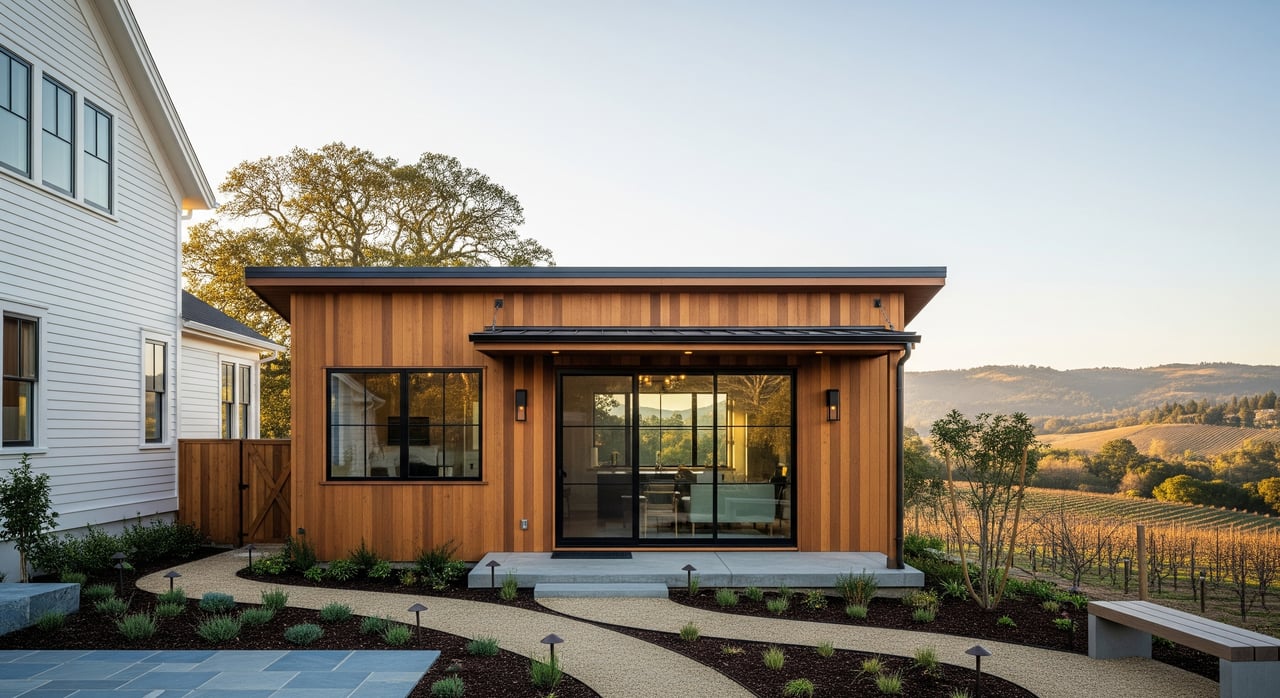
Thinking about adding a backyard home in Petaluma? An ADU can create rental income, space for loved ones, and long-term flexibility, but the rules and costs can feel confusing. This guide gives you clear, local basics: what an ADU is, how much it may cost in the Petaluma area, how permits work, how long it takes, and how an ADU can affect value. Let’s dive in.
What counts as an ADU?
ADU types explained
Accessory dwelling units come in a few common forms:
- Detached ADU: A separate stand-alone unit in your yard.
- Attached ADU: An addition or a connected unit to the main home.
- Conversion ADU: A converted garage or other existing space.
- Junior ADU (JADU): Up to 500 sq ft within the existing home. JADUs often share kitchen facilities, and owner-occupancy rules may apply.
State law supports ADU production and streamlines many approvals, while local jurisdictions apply objective standards on design, setbacks, and utilities. That means you plan to state rules but permit locally.
City vs county rules
Inside city limits, the City of Petaluma manages ADU permits. In unincorporated areas, Sonoma County handles planning, building, and environmental health. Standards can differ for setbacks, height, parking exceptions, and design. Many city parcels connect to municipal sewer, while some rural county parcels rely on septic systems. Septic capacity can be a gating issue and may require upgrades. Properties in higher fire-risk zones may face added requirements for defensible space, access, or fire department review.
Petaluma ADU costs
What drives price
ADU budgets include several parts:
- Soft costs: Design or pre-approved plans, engineering, surveys, site analysis, utility capacity checks, and permit and consultant fees.
- Hard construction costs: Site work, foundation, framing, roofing, windows and doors, insulation, plumbing, electrical, HVAC, kitchens and baths, interior finishes, and landscaping.
- Utility connections: Sewer or septic work, water connection or meter, and electrical panel upgrades.
- Inspections and contingency: City or county inspections and a reserve for surprises. Many owners set a 10 to 20 percent contingency.
Costs vary with size, scope, finishes, site conditions, and whether you are on sewer or septic. Steep lots, retaining walls, long trenching runs, and utility upgrades can add significantly.
Typical cost ranges
These ranges reflect Bay Area conditions and recent market examples for the region:
- Garage or small conversion (about 300–600 sq ft): roughly $80,000 to $250,000, depending on existing conditions and finishes.
- Detached ADU (about 500–1,000 sq ft): often $150,000 to $500,000+. Complex sites or premium finishes can go higher.
- Larger or high-end detached ADU (1,000+ sq ft): can exceed $500,000, especially with separate utilities or heavy site work.
Labor markets, materials, and supply chains can move these numbers. Local builder quotes will give the most accurate estimate for your property.
Fees and size exemptions
State law limits or exempts certain impact fees for smaller ADUs, historically under 750 sq ft. Local permit, plan check, and connection fees still apply, and totals vary by jurisdiction. Expect separate reviews for sewer or water connections, and added costs if capacity upgrades are required.
How to pay for it
Common financing options
Owners often mix funding sources based on timeline and equity:
- Cash
- Home equity line of credit (HELOC) or home equity loan
- Cash-out refinance
- Construction or renovation loans from private lenders
- In some cases, loan programs such as 203(k) for qualifying conversions
Lender terms and ADU eligibility vary. Many owners speak with more than one lender to compare rates, draws, and underwriting for income-producing units.
Programs to ask about
From time to time, California and local agencies offer ADU incentives, pre-approved plans, or pilot financing programs. It is smart to check the City of Petaluma, Sonoma County, and state housing resources for current offerings before you finalize your plan.
Permits and timeline
Permit path at a glance
Most projects follow a similar sequence:
- Pre-application and site checks: Verify zoning, lot coverage, setbacks, utilities, and whether your property sits in a floodplain or a wildland–urban interface area.
- Design and plans: Hire a designer or consider pre-approved plans. Prepare site plan, floor plans, elevations, and structural details.
- Agency referrals: Planning, building, public works for water and sewer, fire department, and environmental health for septic on non-sewered parcels.
- Permit submittal and review: Many code-compliant ADUs qualify for ministerial review using objective standards.
- Permits issued, inspections, and final occupancy: Schedule inspections and obtain final sign-off.
Ministerial vs discretionary
If your ADU meets objective standards, the city or county can review it ministerially, which is typically faster and does not require a public hearing. Projects that seek exceptions or variances may trigger discretionary review, which adds time and uncertainty. Designing to objective standards is one of the best ways to keep your timeline predictable.
How long it takes
Timelines depend on scope and workload:
- Pre-application and checks: a few days to a few weeks
- Design: 4 to 12+ weeks
- Ministerial permit review: often 2 to 4 months; discretionary projects can take 4 to 9+ months including revisions
- Construction: conversions about 2 to 4 months; detached ADUs often 3 to 8+ months
From first idea to move-in, many projects run 6 months on the fast end to 12–18 months for new detached units or complex sites.
Petaluma-specific checks
- Confirm jurisdiction: City of Petaluma or unincorporated Sonoma County.
- Verify sewer vs septic early. If septic, request a feasibility review because capacity upgrades can be costly or infeasible.
- Ask planning staff for objective design standards to target ministerial approval.
- If in a higher fire-risk area, expect fire access and defensible space requirements.
- Coordinate with utilities on water, sewer, and electrical capacity and any separate permits.
Value and resale impacts
Rental income potential
ADUs can create steady rental income that offsets your mortgage or supports long-term goals. Rents vary by size, quality, and location within the Petaluma area. If you are considering short-term rentals, check local rules and licensing because cities across Sonoma County regulate vacation rentals and transient occupancy taxes.
Appraisals and resale
A properly permitted ADU can increase market value and widen your future buyer pool. Appraisers may consider the income potential when evaluating a property, especially if you document rent history. Value gained is not always dollar-for-dollar against build cost; it depends on unit size, permitted status, finishes, and local demand. Good records and permitted status help both appraisal and buyer confidence.
Taxes and insurance
Adding an ADU typically increases assessed value, which can affect your property taxes. Rental income is taxable, and some expenses may be deductible. Homeowner insurance usually needs to be updated to reflect the added structure and any wildfire-related features, and premiums may change with risk. Many owners speak with a tax professional and their insurer before construction starts.
Local homeowner checklist
Use this quick path to plan smart and avoid surprises:
- Confirm whether you are inside the City of Petaluma or in unincorporated Sonoma County.
- Verify sewer connection or septic capacity; request utility capacity letters if needed.
- Check zoning, lot coverage, setbacks, and any overlays like floodplain or WUI.
- Schedule a pre-application meeting with the local planning and building department.
- Order a site survey and evaluate drainage, grading, and tree protection needs.
- Build a preliminary budget that includes soft costs, hard costs, connections, and a 10–20 percent contingency.
- Explore financing options with lenders familiar with ADUs.
- Ask about pre-approved plans or plan review fast-tracks that meet objective standards.
- Collect documents early: site plan, architectural set, structural details, soils or septic reports, and utility capacity confirmations.
- Hire licensed contractors with ADU experience and keep records of permits, inspections, and as-builts.
- After final inspection, update insurance and organize documents; keep any rental records for future appraisal or resale.
Ready to plan your ADU?
Whether you are building for income, multi-generational living, or future resale, a clear plan can save you time and money. If you want to understand how an ADU could impact your home’s market value or your timing to sell, connect with a local advisor who knows Petaluma’s permitting landscape and buyer demand. For tailored guidance and access to a vetted vendor network, reach out to Jen Birmingham.
FAQs
How much do ADUs cost in Petaluma?
- Conversions often range from about $80,000 to $250,000, while detached ADUs around 500–1,000 sq ft commonly run $150,000 to $500,000+, with larger or complex builds exceeding $500,000.
How long do permits and construction take in Petaluma?
- End-to-end timelines often span 6 to 18 months: design 4–12+ weeks, ministerial permit review 2–4 months, and construction 2–8+ months depending on scope.
Are fees waived for small ADUs in Petaluma?
- State law limits certain impact fees for smaller ADUs, historically under 750 sq ft, but local permit and connection fees still apply and vary by jurisdiction.
Will an ADU raise my property taxes and insurance?
- Yes, an ADU typically increases assessed value and can change your insurance needs and premiums; many owners review plans with their insurer and a tax professional.
Can I rent out an ADU short-term in Petaluma?
- Short-term rental rules vary by city and may require licenses or taxes; check local ordinances before planning for vacation rental income.
What are common ADU deal-breakers around Petaluma?
- Septic capacity limits, complex or steep sites that require heavy site work, projects needing variances, and added wildfire mitigation requirements can all add cost or time.